Monday, 19 June 2017

EDUCATIONAL AND TRAINING FOR RECORDS MANAGEMENT PROFESIONAL


Education and training for records management professional
Nur Syamimi Binti Rahman @ Wagi
UiTM Puncak Perdana

Abstract
This study is about the education and training for record management professional. The records management professional  are need to give education and training. In this study also will reveal how education and training will affect the records management professionals. This paper aims to explore the definitions of and the differences between education and training and the role of each in nurturing and supporting lifelong learning for records professionals
Keywords : Education and training, records management, professional

Introduction
            Education and training are very important for records management professional. Education provides new professionals with knowledge of theory of the discipline and helps them to explore current practice. It provides the informationseeking skills and encourages a reflective habit that underpins independent lifelong learning. Training focuses on acquisition of specific skills and competencies necessary in the workplace. More is needed for a viable professional future; education for research is essential to the development of professional knowledge and for the survival of education programmes in universities.
             
What is education and training for records professionals?
            Every organization stresses training and it is a legal requirement in many industries. Training managers and human resource personnel spend countless hours identifying, preparing, and delivering training. After training, we test to assess competency and mastery of information and skills.With any training program, there are the associated training records. Records document who was trained, when they were trained, and what skills they have mastered. Training records provide documentation for regulatory agencies, information for personnel evaluations, and support for promotion or salary increases.
Training records can be used as a basis for goal setting or aid in selecting staff assignments by matching competencies with required skills. They also are useful for charting and reviewing personal progress toward annual goals. Records are objective. They provide the data needed to make decisions based on actual performance after specific training. Records provide an easy method to identify training gaps that direct future subject matter. As a reminder, this gap analysis assesses the needs of the organization and the knowledge, skills, attitudes, and abilities (KSA) of the staff in relation to the jobs they perform.
            The meaning of education is the act or process of imparting or acquiring general knowledge, developing the powers of reasoning and judgment, and generally of preparing oneself or others intellectually for mature life. In simple words, education is the act or process of imparting or acquiring particular knowledge or skills, as for a profession.  The meaning of training is teaching, or developing in oneself or others, any skills and knowledge that relate to specific useful competencies. Training has specific goals of improving one's capability, capacity, productivity and performance.
            However, people with the knowledge, skills and abilities required to build a recordkeeping infrastructure that is relevant to the accountability and programme delivery requirements of the government have yet to be trained and recruited. Given these record-keeping challenges, how will the Malaysian government proceed? While countries such as the UK and some of the European States have proceeded with developing education and training programmes, as well as a series of guidelines and toolkits on ERM for the key players, countries like Australia and Canada have embarked on large-scale of research.

            McDonald (1998), Hare (2003), McLeod, Hare & Johare (2004) have suggested that education, training and recruitment strategies should be established to ensure that the administrators, records managers, archivists and IT personnel who are responsible for the record-keeping infrastructure in the government have the necessary knowledge, skills and abilities to perform their jobs. Based on these suggestions, education and training strategies should be designed for, and reach out to, the existing record keepers in the public sector in general and the Malaysian government in particular.

Important of Further Training and Education For Records Professionals
            Organization of records today must do everything possible to stay competitive and maintain a highly skilled, motivated staff. Despite today’s very competitive job market, employees often have little hesitation when it comes to searching for a new job if they become unhappy with their current employer. In order to keep employees satisfied, boost morale, and remain competitive, employers need to be aware of the need for continual employee training and education.

Training methods
Patton (1990) and Oppenheim (2000)One of the most popular methods of further training is that of computer-assisted instruction. Employees complete specific modules of instruction, usually at the employee’s own pace. Accurate monitoring of the employee’s progress is possible, and the amount of time an employee spends on a specific module is adjustable, dependent upon need. Another common method of training is the workshop model, where groups of employees learn through a combination of audiovisual aids, games, role-playing, and occasionally through lecture. This method encourages employees to get to know each other and fosters cooperation between different job classifications and departments.

Offering senior staff and management the opportunity to learn about the jobs of the support staff is another frequent choice when companies are considering what types of training employees need. Often, management is unaware of the day to day tasks of hourly employees. They may believe that those employees are not critical to the company’s operation, or that they can be quickly and easily replaced. Training management-level employees to do non-management tasks encourages an understanding and appreciation among all company personnel and can give rise to new ideas and suggestions for improvements to current practices. EmpXtrack Training Management helps you to identify the unique training needs, skills and competencies for each employee. We also ensure that managers are closely involved in the training process and create a schedule that actively meets the training gaps in your organization.

Cross-training
When employees learn cross-training, which is learning to do the jobs of other employees, , the business gains security as it enables an employee to step in should another become unavailable due to illness, leave of absence, or promotion. The company can remain productive when the option of relocating employees as needed, is available. In addition, exposing staff to different jobs and departments within the company helps them to understand how each position is important to the big picture. Employees understand the value of each role and develop a greater respect for individual contributions. This is a morale booster and a great way of encouraging respect among employees.Evans, F(1990).

Businesses wishing to retain their best employees and stay competitive must offer further training to their personnel. Employees respond positively to the opportunity to improve their job skills, which results in greater job satisfaction. Stella Workman is a freelance blogger who usually writes about saving accounts over at SavingsAccount.org. Her recent review looked at where to get good savings account rates.
  
Records Professional Recognition

            According to McLeod, Hare and Johare (2004),In order to keep records professinal motivated about training, recognition of accomplishments is vital. We live in a world where employee pats on the back are expected. Younger team members especially are used to receiving recognition and kudos for even the smallest achievements. It follows that they would also expect recognition for these work-related achievements. For major events, such as achieving a certification or a specialty certificate, monetary rewards and sometimes promotion are standard. Often this is coupled with a mention in a company newsletter, a plaque on the wall, or a celebration lunch. But what about routine training? Do we recognize staff enough for ongoing mastery of new materials and new techniques? Such recognition does not need to be expensive or complex. A mention during a staff meeting or a monthly lunch to celebrate new masteries, are an easy way to provide that pat on the back in a meaningful way.

Some other suggestions include:

·         Initiating a “Trainee of the Month” program;
·         Recognizing achievement in a departmental email;
·         Rewarding staff with trips to local or regional meetings;
·         Allowing successful students to assist with training for less skilled employees;
·         Posting photos of successful trainees with their specialty listed;
·         Using masteries of new material as part of the employee evaluation process;
·         Including training expectations as part of an annual goal-setting exercise;
·         Sending a letter of congratulations from HR or higher level manager;
·         Listing achievements in a monthly or quarterly in-house or professional society newsletter.

Another suggestion is to use competent staff as the core of a “Train the Trainer” program, building on their success to motivate other staff members to achieve.

Organizational behaviour is important as it tells employees what is valued.2 If we value training, we need to recognize those employees who strive and achieve, not just for major milestones, such as certification, but for dedicated and ongoing learning. Training records can help determine who those dedicated employees are.

Conclusion
            For the conclusion, the education and training are very important to records professional. Education and  training  not only important to the professionals worker but also important to the staff. Education and training have to do regularly to the professionals records so that the professional are expert in their profession. If high quality care is to be maintained, education and training is needed to provide staff with the necessary knowledge and skills to adapt to their changing roles. Developing your employees' skills through training can improve your business and help it stay competitive. Other benefits of training include greater staff retention and commitment a qualified workforce, increased productivity, improved quality and less wastage.

Reference

Karen Anderson, (2007) "Education and training for records professionals", Records
            Management Journal, Vol. 17 Issue: 2, pp.94-106.

McDonald, J. 1998. The role and position of records management in government.
Paper presented at the International Conference on the Transition to ElectronicRecords as a Strategic Resource, 22-24 June, Kuala Lumpur.

            McLeod, J., Hare, C. & Johare, R. 2004. Education and training for records
management in the electronic environment – the (re)search for an appropriate
model. Information Research, Vol. 9, no.3, paper 179.
            Patton, M.Q. 1990. Qualitative evaluation and research methods. (2nd ed.). Newbury
Park: Sage
            Oppenheim, A.N. 2000. Questionnaire design, interviewing and attitude
measurement. (New edition). London: Continuum.
McLeod, J., Hare, C., & Johare, R. (2004). Education and training for records
management in the electronic environment– the (re)search for an appropriate model. Information Research, 9(3) paper 179. Retrieved June, 28, 2005 from web site: http:// InformationR.net/ir/9-3/paper179.html].

Hare, C., & McLeod, J. (1999). Developing a research profile: a case study from  the          United Kingdom. Records Management Journal, 9(3), 219-233.

            Johare, R. (2001). Electronic records management in Malaysia: the need for an
organizational and legal frameworks. Records Management Journal, 11(2), 97-110.

KEY STAKEHOLDER IN BUSINESS

Key Stakeholder in Business

Nur Natashah Binti Zainal
Faculty of Information Management,
Universiti Teknologi Mara, Malaysia


Abstract:
In this article, it is explain about the key stakeholder in a business field. Key stakeholder is individual or organizations that affect or affected to the input and outcomes of the business. In this article, it is explain about the type and role of the stakeholder both internal and external. It is also explain about process on how to identify key stakeholder. It has five processes to make sure manager carefully on identifying the stakeholder. Business also will face different needs of stakeholder. Therefore, in this article also explain on how to deal with different stakeholders.
Keywords:
Key stakeholder in business, Key stakeholder, Business, Stakeholder.


1.0 Introduction

In a term in economic, business refers to any public or private organization that sale their product or services to fulfill customer needs and the main objective of business is to earn profits. According to article in website by Umar farooq (2012), business is a source to gain wealth that depends on work, efforts and acts of people or human. In a nature of business, as a nature of human in business field, they always want and want more and for satisfying their needs, they works and works harder. Characteristics of business are, production or acquisition of goods which is every business will deals with goods (may produce, manufacture or procure) and services, Profit which it is the basic motivation business to ensure the survival of the business, Risk which is businessman or woman will face uncertainty of their future of business, dealing in goods and services which is deal with goods and services to supply to those who need it and regular dealing which is it is important characteristic in business because business needs to keeps restock and sells to customer regularly to continues survive.
Key stakeholder can be define as individual or group of people who are affects or affecting directly or indirectly to achieve the objectives and goal of the organization to run their business. Freeman (1984). In general, the concept of stakeholder is about what the business should be and how it should be viewed. Organization itself should consider them as group of stakeholder and the objectives of the organization are need to manage the importance, needs and perspective that related to their business. Stakeholder management is considered to be fulfilled by the manager of the firm. Manager should manage the corporation to ensure the right of stakeholders and the participation in decision making and manager has to act as shareholder in their business to ensure the survival of their business and to protect long terms of the business. Friedman (2006). Stakeholder also can be defining as groups that important for the survival and successful of the business. Freeman (2004). In the book of Freeman (1984), he said without groups of support, the organization will not exist and cannot survive. Examples of stakeholders are customers, employees, business partners, competitors, local communities, supplier and distributors, shareholder and financiers from other than stakeholder such as creditors. Friedman (2006).
In business field they will always face and have relation with stakeholder to run their business. Therefore, key stakeholder is really important in a business field because to make sure their business continues survive, there must to take care of their stakeholder that will make sure or help to work in order to achieve the objectives and goal of the business.


2.0 Types of key stakeholder and their role

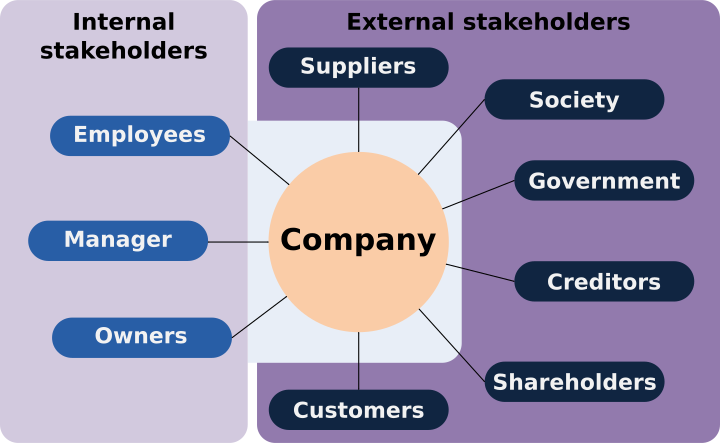
There are internal and external key stakeholders. An internal stakeholder is anyone who is within the organization that working to achieve the goal and objective of the organization such as employees, manager and owner. An external key stakeholder is anyone who is not within the organization but concerned about the business and affecting the business performance such as suppliers, society, government, creditors, shareholders and customer.


Figure 1: Types of key stakeholder


By: Boundless (2016)

2.1 Internal key stakeholder:

2.1.1 Employees
It is the key stakeholder group because an employee will contribute their labor and expertise in the organization and it is also the link between the product or service and the customer. Money that is invest to the employees for their selection and training is not futile because it can lead to increased satisfaction and competence of employees and this also will lead to good services and increase customer satisfaction and at the end it also will lead to the growth and success of the business organization. Boundless (2016).

2.1.2 Manager
Manager play as a main role in the business which is manager has to set strategies of the organization such as goal and objective, vision and mission of the business. Others than that, manager is important to make any decision regarding to the business activities and manager is an important person who link between shareholder, the board of directors and their organization. Boundless (2016).

2.1.3 Owners
Owners are an individual who hold the significant share of the organization including publicly traded organizations. As an owner of the organization, they have responsibility to the impact of the organization and as a main role in the strategies of the organization. Owner often make important decision regarding internal and external stakeholder. Boundless (2016).

2.2 External key stakeholder:

2.2.1 Suppliers
Steven Bragg said, supplier also known as vendor which it is an individual or organization that will provides their products or services to others organization. Usually suppliers consist of manufacturer or distributor.

2.2.2 Society
There are defined as people, groups, organizations or business. Business can be affected or be affected by society actions, objectives and policies. Examples of society stakeholder are residents, community groups, developers, government workers, business owners, neighborhood leaders, commission members and others. Ruth (2016).

2.2.3 Government
Government is important in business field to strengthen their success because government is business tax. Government is key stakeholder because government will affected to the profit of the business. Government also will ensure that accounting procedure, ethical practices and legal concern are handled responsibly by business representatives. Boundless (2016).

2.2.4 Creditors
Creditors are someone who lends the money to the business so that they can run their business and creditor has agreed to receive the payment later. It is as resources to the business to help them in terms of money. Creditors will interested in business that they know the business capable and has enough money to pay them back later. Boyu Xu (2013).

2.2.5 Shareholders
Shareholders consist of person, company or institution that at least has one share of company stock. They also will get the benefits of the company profit because they are also a company owner. They also will be affected by the loss of the business in which they will lose the money they invested in the business. Ayton MacEachern (2017).

2.2.6 Customers
Primary purpose of providing goods and services is to fulfill the needs of human. Understand the needs of customers with the optimizing operations to fulfill the needs of customers are a significant part of managing a business. Boundless (2016).


3.0 How to identify stakeholders to success in business.


Figure 2: Process to Identify Stakeholders.

By: Lynda Bourne (2009)

It is important to carefully identify your stakeholder because it has limited resources and organization cannot do everything for everyone. To identify stakeholders, you will have large list in a short time. If you cannot focus to the important relationships, management and staff will be running in all direction and did not meet the requirements. Graham Kenny (2014). So, there are five steps that can help to identify key stakeholders in your business which are identify stakeholders, prioritize your stakeholders, understanding and managing your stakeholders, setting goals and identify costs of stakeholder analysis and evaluation and revision. It will help to direct your organization energy and activities. Kennon, Howden and Hartley (2009).
First step is identifying stakeholders. It is a process to identifying who is involve in the business and discuss with a team why they are important to meet the business objectives and goal. It is important to focus to their role in the business and not just a collection organization or the title position. This is because, individual or organizations have different levels of power or different important to the organization and maybe have a different relationship with various teams member. It is important because this is to form a network and not an organization. Kennon, Howden and Hartley (2009).
Second step is priorities your stakeholders. It is means, give the priorities to stakeholders in term of how critical they are in the success of these business. This is also can help in priorities the communication and discussions with the stakeholders that will most affect the success of a business. Important people and influential people in business is different but it is have the same important to the success of the business which means, important people is refers to those who have power over the delivery of project outcomes and influential people is refers to peoples who have power direct or indirectly in the success of the business. Example of important peoples are, leaders, critical knowledge resources and providers of resources and the example of influential peoples are financial people and people that have power to  the key decision maker in the business activities. Kennon, Howden and Hartley (2009).
Third step is understand and managing the stakeholder. It is involve on considering such attitude of the stakeholder to the project, attitude of the stakeholder to the team and any risk that will associated with their involvements in the project. Then, you have to consider on what changes required in how you involve you involve them to decrease any risk and increase their appreciation and commitment to the project. Kennon, Howden and Hartley (2009).
Fourth step is setting goals and identify costs of stakeholder analysis. It is requires team to prescribe their responsibilities to carry out communication task and to set appropriate timelines. Kennon, Howden and Hartley (2009).
Fifth step is evaluation and revision. This process will be carried out regularly throughout the life of the project. It will be most beneficial when analysis about the stakeholders always updated to identify whether there are potential for new stakeholders, changes in current stakeholders or if perception of the project have change. Kennon, Howden and Hartley (2009).


4.0 How to relate with different types of stakeholders

With the analysis about the key stakeholder, manager will collect enough information about their stakeholders to build a strong relationship without regardless of the differences between them. For example, if manager deal with director of marketing and chief information officer, the needs and want from them will be different. Therefore, engagement with each must be different as well.
Stakeholder with financial concern have to know the potential return of the business outcomes and if there is a problem, others will support to improving operations, increase market share, increasing production or meeting other company objectives.
Remember that company interest are most important than individual or stakeholder interest. Therefore you must keep each stakeholders expectations and needs in mind.
Stakeholders will respect on what the needs of the organization if the attitude of manager of business activities are excellent such as always be honest even when need to tell key stakeholder something that they do not want to hear, can be predictable and reliable, stand by their own decisions and takes accountability for mistakes. Adriennie Watt (2010).


5.0 Conclusion


As a conclusion, stakeholder is important to help the success of the business and because of that, manager must carefully in identify, managing and know how to maintain the relationships with the stakeholders. The important people that business must focus on to increase their profit or to maintain the success of the business is not on customer only but also to their owners, manager, employees, supplier, society, government, creditors and shareholder. There are a lot of things that manager must control and manage. Because of that, manager must use the process on how to identify and manage their stakeholder for their organization carefully to make sure their business will run well for the future of the business.